Cryptids & Strange Creatures
Why Phantom Black Dogs Haunt So Many Local Legends
Black dog stories reveal how roads, boundaries, danger and memory gather into a repeated supernatural form.
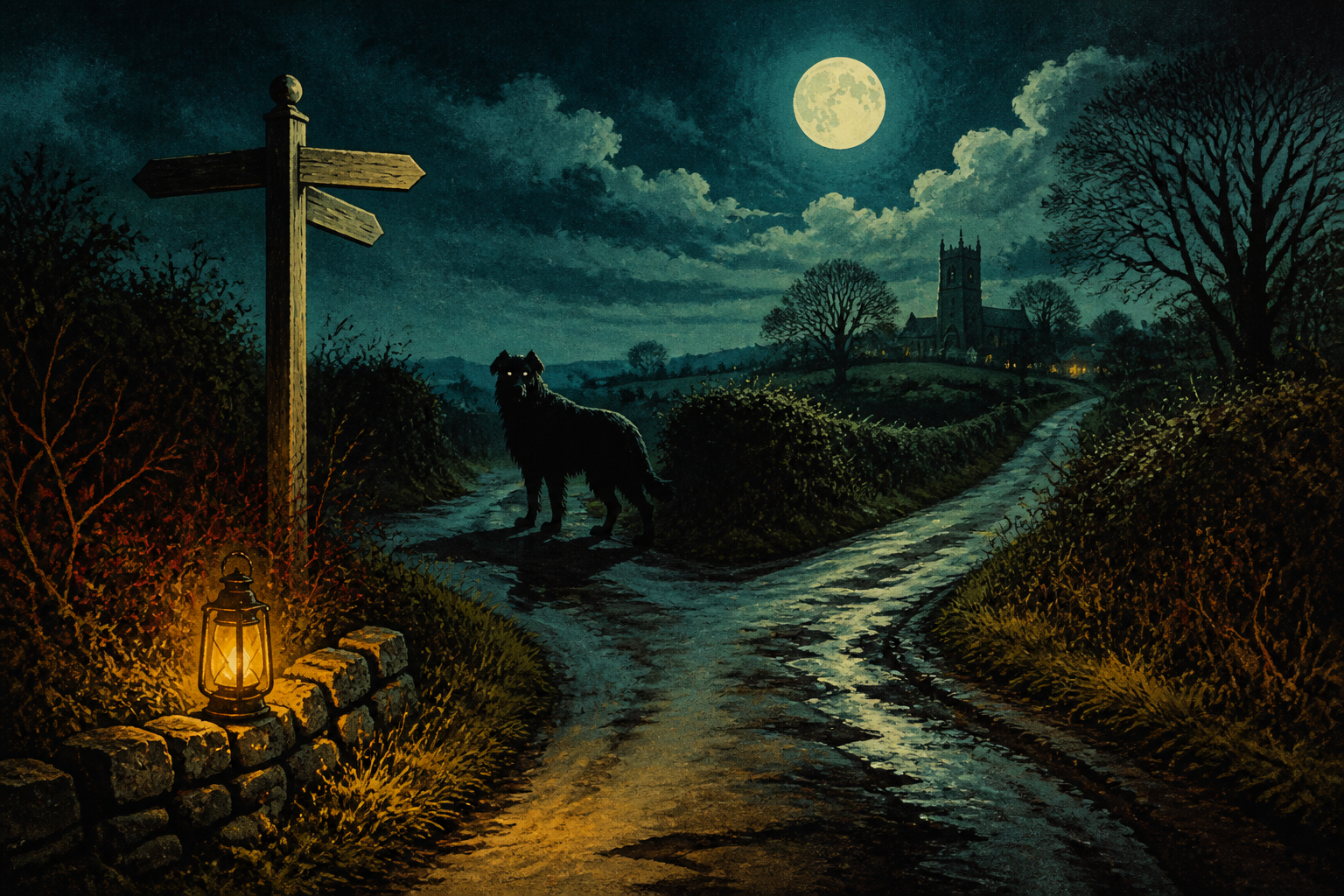
The black dog is a travelling legend. It pads along lanes, churchyards, bridges, coast roads and field boundaries, usually appearing where people already feel exposed.
Some stories behave like warnings. Others resemble grief images, death omens or local explanations for a frightening night journey. The animal form is flexible enough to absorb many fears while remaining instantly recognisable.
Modern sightings often borrow old motifs without consciously repeating them. That is part of their interest: folklore can survive as a shape of attention, not only as a story told by name.
The setting matters. Phantom black dogs are rarely placed in random daylight. They favour roads, bridges, church paths, lanes, coast edges, moorland tracks and places where a walker becomes aware of distance from safety. The dog is not only an animal; it is a boundary with teeth.
In some accounts the dog warns. In others it threatens. Sometimes it appears before a death, sometimes after one, sometimes near a place associated with burial, crime, accident or old rights of way. The same shape can carry different local work depending on what the community needs the story to remember.
There are ordinary animals behind some reports: loose dogs, large breeds glimpsed at night, foxes, deer, escaped big cats in modern versions, or shadows made animate by headlights. But a natural explanation for one sighting does not explain why the story-form is so persistent.
The black dog survives because it is simple, portable and emotionally exact. It gives a body to the feeling of being watched on a lonely road. It turns caution into a creature. That is why the archive treats these reports as folklore, perception and landscape history at once.
Common Motifs
Large size, dark coat, glowing or reflective eyes, silence, sudden disappearance, crossroads, bridges, churchyards and a sense of warning recur across many regional versions.
Questions for a Sighting
Was the witness moving or stationary? Was there traffic light, mist, rain or livestock nearby? Were local black-dog legends known before the sighting? Did the animal leave tracks, sound or physical interaction?
Why the Legend Travels
A black dog can belong to a named village and still feel familiar elsewhere. The story is local in detail but universal in emotional grammar: night, road, danger, threshold.
Sources and Further Reading
- Local folklore collections
- County history publications
- Open access folklore scholarship
Claim, Context and Cautions
- Common Motifs
- Large size, dark coat, glowing or reflective eyes, silence, sudden disappearance, crossroads, bridges, churchyards and a sense of warning recur across many regional versions.
- Questions for a Sighting
- Was the witness moving or stationary? Was there traffic light, mist, rain or livestock nearby? Were local black-dog legends known before the sighting? Did the animal leave tracks, sound or physical interaction?
- Why the Legend Travels
- A black dog can belong to a named village and still feel familiar elsewhere. The story is local in detail but universal in emotional grammar: night, road, danger, threshold.
Sources and Further Reading
- Local folklore collections
- County history publications
- Open access folklore scholarship