UFOs & Sky Phenomena
How Ordinary Lights Become Extraordinary UFO Reports
Aircraft, satellites, planets, drones and atmospheric effects can become strange when context is missing.
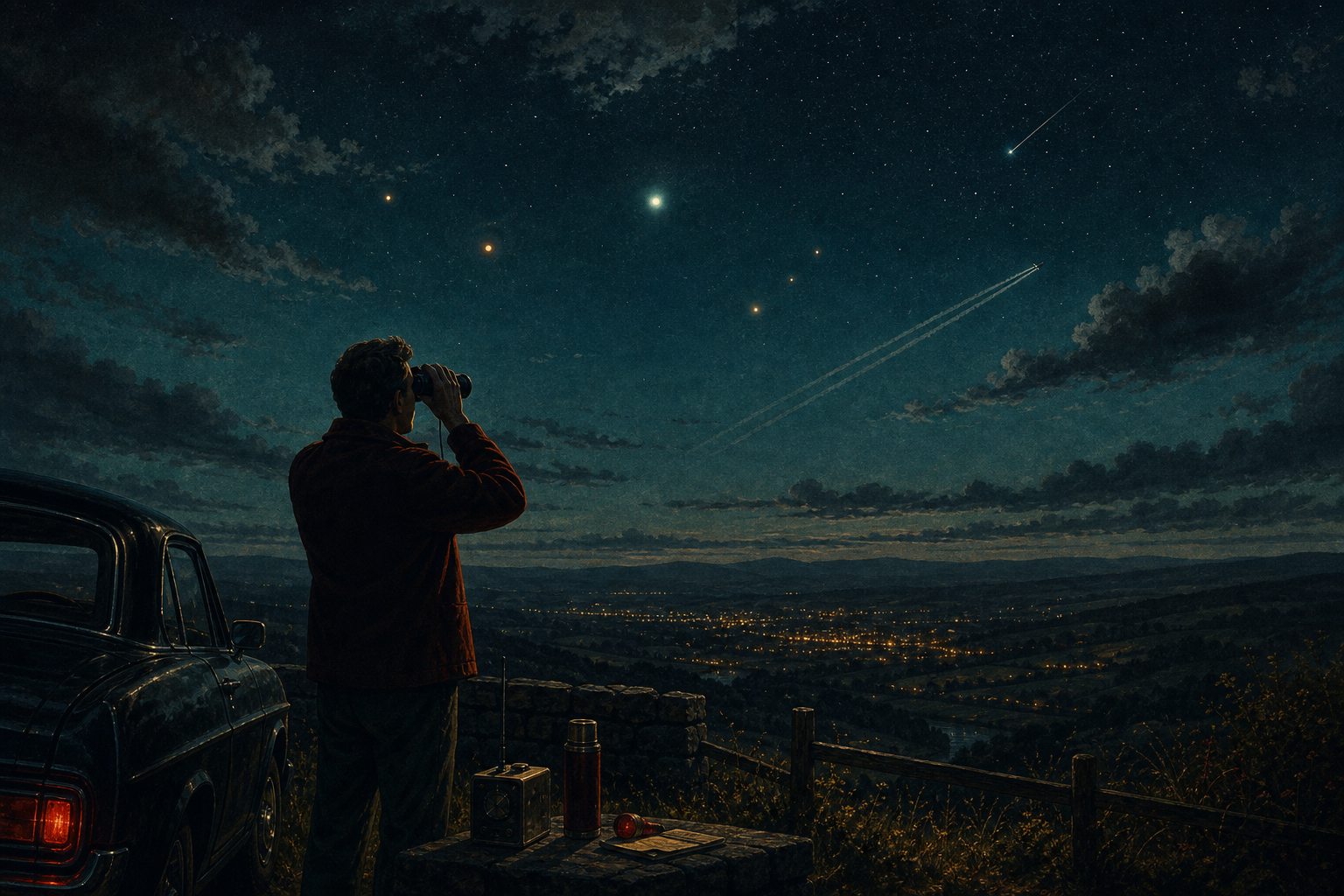
A light in the sky is a poor witness to itself. Distance is hard to judge, speed is easily misread and silence can make a distant aircraft seem impossible.
The best first step is boring in the best way: check the time, direction, duration, cloud cover, flight paths, satellite passes, planets and local events. Many impressive reports become understandable only after those details are placed back around them.
That does not make witnesses careless. It means the sky is an enormous stage, and human perception was not built to identify every moving light above it.
The most common mistake is treating brightness as closeness. Venus can look like a hovering object. A distant aircraft turning toward the viewer can seem stationary, then suddenly move. A satellite train can look arranged. A drone can feel too quiet until wind direction and distance are considered.
Duration matters. A meteor is usually brief. A planet holds position relative to the stars. Aircraft lights change with angle. Satellites move steadily and fade when entering shadow. Chinese lanterns drift with wind and often appear in groups. None of these explanations should be forced, but each should be checked.
The archive asks for direction in plain terms: facing north, object moved left to right, elevation above horizon, visible stars, cloud breaks, nearby airports, phone camera settings. A report with these details is valuable even if the final explanation is ordinary.
Some aerial reports remain hard to settle because the crucial measurements were never made. That uncertainty should be kept honest. ‘Unidentified’ is not a conclusion about origin. It is a statement about the limits of the record.
First Checks
Record time, direction, duration, colour, sound, movement, weather, aircraft routes, satellite passes and bright planets. If filming, keep the original file and note whether zoom or night mode changed the image.
Why Silence Misleads
A distant aircraft, wind direction, urban noise or observer attention can make a normal object seem impossibly silent. Silence is a clue, not a verdict.
A Better Word Than Belief
Good sky research is not about belief first. It is about reconstruction: where was the observer, what was visible, what moved, what records exist and what explanations remain after checking.
Sources and Further Reading
- NASA skywatching resources
- Civil aviation public data
- Meteorological office explainers
Claim, Context and Cautions
- First Checks
- Record time, direction, duration, colour, sound, movement, weather, aircraft routes, satellite passes and bright planets. If filming, keep the original file and note whether zoom or night mode changed the image.
- Why Silence Misleads
- A distant aircraft, wind direction, urban noise or observer attention can make a normal object seem impossibly silent. Silence is a clue, not a verdict.
- A Better Word Than Belief
- Good sky research is not about belief first. It is about reconstruction: where was the observer, what was visible, what moved, what records exist and what explanations remain after checking.
Sources and Further Reading
- NASA skywatching resources
- Civil aviation public data
- Meteorological office explainers