UFOs & Sky Phenomena
The Battle of Los Angeles: Searchlights, Shells and Wartime Nerves
In February 1942, Los Angeles saw searchlights, anti-aircraft fire and rumours of enemy aircraft in a case where fear, weather and uncertainty lit up the sky.
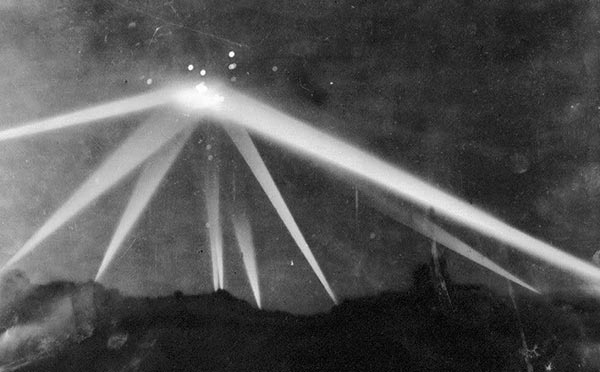
The Battle of Los Angeles is a sky mystery built from fear as much as light. In the early hours of February 25, 1942, sirens sounded across Los Angeles. Searchlights swept the sky. Anti-aircraft guns opened fire. The city, already tense after Pearl Harbor, behaved as if an attack was underway.
What exactly triggered the response remains less dramatic than the image it produced. Reports varied. Some observers believed aircraft were present. Others saw smoke, shell bursts, beams and confusion. In blackout conditions, with nerves tuned to invasion, the sky became a surface onto which expectation could be projected.
The famous photograph is part of the problem. Searchlights converging through smoke create a centre of attention even if there is no clear object at the centre. A viewer wants the beams to reveal something. The image’s composition almost demands a target.
That visual drama helped the event survive in UFO culture, especially after the war. But a responsible reading has to begin with the wartime context. Air defence systems were alert, rumours moved quickly, and no one wanted to be the person who ignored a real attack.
The official and journalistic aftermath did not produce one tidy answer. Weather balloons, overreaction and confusion were discussed. The lack of a recovered aircraft matters. So does the very real fact that guns fired and people experienced the night as an emergency.
The case is therefore not best filed as simple hoax or simple UFO. It is a study in perception under pressure. Searchlights, smoke, shell bursts, official uncertainty and media urgency created a public event that felt more coherent than the evidence behind it.
For Devil’s Hideout, the Battle of Los Angeles belongs beside ordinary lights becoming extraordinary reports. It shows how a sky event can be made by technology, fear, light, weather and interpretation all at once.
Why the Photograph Matters
The image is visually powerful but ambiguous. Searchlights and smoke can create the impression of a target even when the target is not independently visible.
Context First
Any interpretation has to begin with February 1942: wartime alert, coastal anxiety, blackout conditions and fresh fear after Pearl Harbor.
Case Notes
- Claim
- Anti-aircraft batteries fired over Los Angeles after reports of enemy aircraft, producing one of the most dramatic American sky scares of World War II.
- Background
- The event occurred soon after Pearl Harbor, when coastal fear, alert systems and rumours of attack were intense.
- Reported events
- Sirens sounded, searchlights crossed the sky and anti-aircraft fire erupted. Reports differed on whether aircraft, balloons or nothing definite had been seen.
- Possible explanations
- Suggested explanations include war nerves, weather balloons, flares, misread radar or visual reports, smoke, shell bursts and confusion amplified by blackout conditions.
- Sceptical view
- The event is not strong evidence for extraordinary craft; it is stronger evidence for how uncertainty behaves under wartime pressure.
- Why it still interests people
- It remains compelling because the photographs and headlines are spectacular, while the underlying trigger remains contested and messy.
- People or entities
- Los Angeles residents, U.S. Army anti-aircraft units, Wartime press
Sources and Further Reading
- Wikimedia Commons: Battle of Los Angeles photographPublic-domain image used for this entry.
- HISTORY: World War II’s Bizarre Battle of Los AngelesAccessible historical overview.
- San Francisco Museum: The Battle of Los AngelesTranscript of an Office of Air Force History account; HTTP source used due certificate issues on HTTPS.
Claim, Context and Cautions
- Why the Photograph Matters
- The image is visually powerful but ambiguous. Searchlights and smoke can create the impression of a target even when the target is not independently visible.
- Context First
- Any interpretation has to begin with February 1942: wartime alert, coastal anxiety, blackout conditions and fresh fear after Pearl Harbor.
Sources and Further Reading
- Wikimedia Commons: Battle of Los Angeles photographPublic-domain image used for this entry.
- HISTORY: World War II's Bizarre Battle of Los AngelesAccessible historical overview.
- San Francisco Museum: The Battle of Los AngelesTranscript of an Office of Air Force History account; HTTP source used due certificate issues on HTTPS.