Unexplained Phenomena
The Grey House Staircase Steps
A model case file showing how repeated household sounds can be documented before conclusions are drawn.
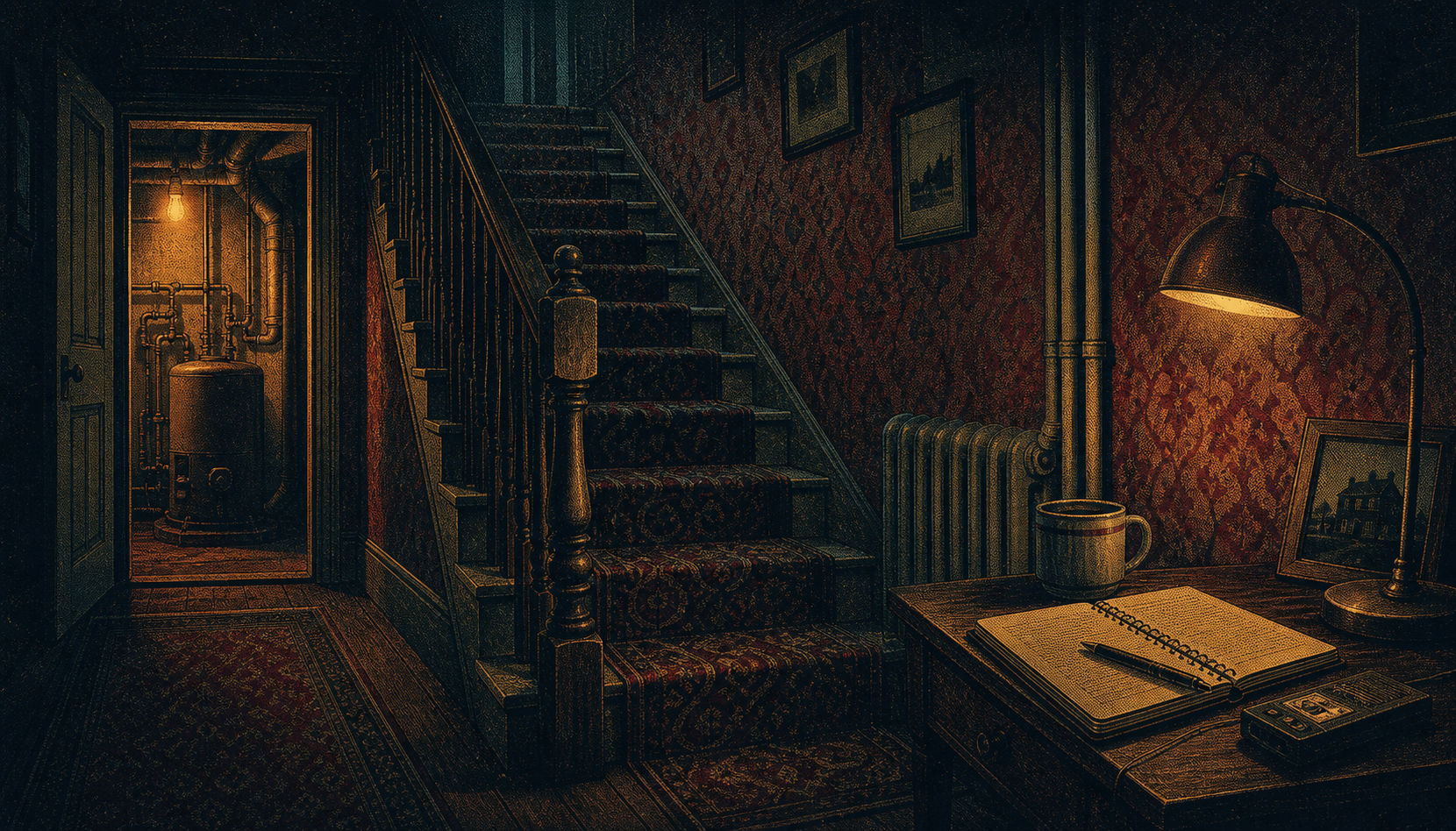
The Grey House file is a composite editorial case built to show how a haunting report should be handled before anyone reaches for a conclusion. Its power is deliberately ordinary: a staircase, a tired household, a newly altered room and a sound that seemed to know the shape of a person.
According to the file, the first night began with three measured knocks from the lower hall, followed by what two witnesses described as a slow descent on the unused back staircase. No figure appeared. No door opened. The disturbing detail was rhythm. The sound had weight, pause and direction, which made it harder for the household to dismiss as a random creak.
On the second night, the witnesses prepared a notebook and agreed not to discuss each sound until it had been written down. That small decision changed the case. Instead of a single dramatic memory, the archive gained a timed sequence: pipe noise at 12:18, a stair-like pattern at 12:41, a radiator tick near 1:05 and one louder report from the wall beside the landing.
The house itself mattered as much as the testimony. A builder later noted recent work near the stair wall and a heating pipe run below the landing. One storage room had been emptied, changing how sound travelled through the upper floor. A closed door that had once absorbed vibration was now left open. The building had become a better instrument.
None of that proves the witnesses were wrong to feel frightened. People do not hear ‘thermal expansion’ in the dark; they hear footsteps. The point is that an archive should preserve the emotional truth of the report while also testing the physical setting. Both can be real at once.
The unresolved portion is timing. Two of the logged sequences matched the boiler cycle closely. A third did not. That mismatch keeps the case interesting, but it does not free the report from ordinary explanations. It simply means the ordinary explanation was not fully demonstrated from the surviving notes.
A stronger investigation would have included an audio recorder, boiler cycle log, floorboard inspection, a sketch of pipe routes and a record of who was awake during each event. Without those, the Grey House remains a useful teaching file: suggestive, human and incomplete.
Case Notes
- Claim
- Several residents reported footsteps descending an unused staircase after midnight.
- Background
- The house had recently undergone structural work, and one room was being used for storage.
- Reported events
- Three nights of knocks and footsteps were logged. A later inspection found heating pipes running below the staircase wall.
- Possible explanations
- Thermal expansion, loose boards, expectation effects and neighbourhood noise remain plausible.
- Sceptical view
- The reported timing matched the boiler cycle on two nights, though not all witnesses accepted that account.
- Why it still interests people
- The case shows why mundane building details should be recorded with as much care as witness impressions.
- People or entities
- Household witnesses, Local builder, Independent interviewer
Sources and Further Reading
- Society for the Protection of Ancient Buildings: advice on old buildingsUseful background for how older buildings move, settle and carry sound.
- Health and Safety Executive: noise at work guidanceGeneral reference for documenting and assessing sound, not a source for this composite case.
- Composite Devil’s Hideout teaching case. No real household, address or private testimony is being represented.
Sources and Further Reading
- Society for the Protection of Ancient Buildings: advice on old buildingsUseful background for how older buildings move, settle and carry sound.
- Health and Safety Executive: noise at work guidanceGeneral reference for documenting and assessing sound, not a source for this composite case.
- Composite Devil's Hideout teaching case. No real household, address or private testimony is being represented.