Cryptids & Strange Creatures
The Jersey Devil: From Pine Barrens Legend to Newspaper Panic
The Jersey Devil shows how regional folklore, landscape and newspaper appetite can turn a local creature story into a durable public monster.
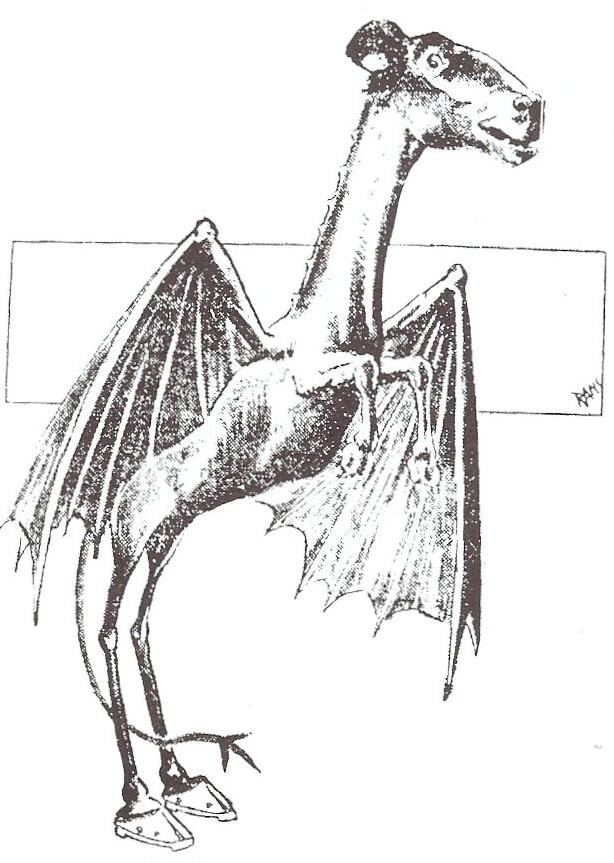
The Jersey Devil is not a single sighting so much as a regional engine for sightings. Its usual territory is the New Jersey Pine Barrens, a landscape that has long supported stories about isolation, night travel, strange sounds and the uncertainty of wooded wetlands. The creature is often described with wings, hooves, a horse-like head, horns or a tail, but the details shift with the teller.
Many versions draw on the Leeds family or Mother Leeds tradition, in which an unwanted thirteenth child becomes monstrous and escapes into the night. Like many origin legends, the story is less a stable historical record than a narrative seed. It gives the creature a birthplace, a family scandal and a moral charge.
The legend expanded beyond fireside storytelling through newspaper attention, especially during the 1909 wave of reports. Newspapers did not merely record the creature; they helped shape it. Illustrations, headlines and repeated accounts gave the Devil a public body, even when the evidence remained thin.
That does not mean every witness was lying. Folklore often grows from sincere experiences interpreted through local language. A cry in the woods, an odd track, a glimpse of an animal in poor light or a frightening night journey can become more definite when a community already has a name for the thing that might be out there.
The Pine Barrens matter as more than scenery. Remote or difficult landscapes often attract boundary creatures: beings that belong at the edge of town, at the end of a road or in the place where ordinary rules feel less certain. The Jersey Devil works because the setting gives the story somewhere to live.
Sceptically, the case is weak as zoology and strong as culture. There is no dependable chain of physical evidence pointing to an unknown winged animal. There is, however, abundant evidence that people use the legend to talk about place, fear, local identity and the pleasure of being just uncertain enough.
For Devil’s Hideout, the Jersey Devil belongs in the archive as a model creature legend. It shows how folklore, newspapers, regional pride and occasional misidentification can keep a monster alive long after any single report has faded.
The 1909 Effect
Newspaper coverage gave the creature a broader audience and helped standardise a visual form that older oral stories did not always share.
Landscape as Evidence
Remote wetlands and forests do not prove a monster, but they create conditions where ambiguous sounds and sightings can become memorable stories.
Folklore Status
The best-supported reading is cultural rather than biological: a durable regional legend repeatedly refreshed by new reports.
Case Notes
- Claim
- A strange winged creature, often linked to the Leeds family legend, is said to haunt or roam the Pine Barrens of New Jersey.
- Background
- The Pine Barrens supplied the ideal landscape for a durable legend: deep woodland, wetlands, difficult travel, scattered communities and a strong oral tradition.
- Reported events
- Stories described screams, tracks, frightening shapes and sudden encounters. In 1909, newspaper attention helped turn scattered claims into a wider public episode.
- Possible explanations
- Possible explanations include folklore transmission, misidentified wildlife, theatrical newspaper reporting, hoaxes, fear of remote places and the way repeated motifs accumulate around a named creature.
- Sceptical view
- There is no reliable biological evidence for a distinct unknown animal behind the legend. The stronger evidence is cultural: a regional story repeatedly adapted to new audiences.
- Why it still interests people
- The Jersey Devil endures because it is flexible. It can be a monster, a warning, a joke, a local emblem, a tourism hook and a symbol of the Pine Barrens all at once.
- People or entities
- Pine Barrens storytellers, Mother Leeds tradition, 1909 newspaper readers
Sources and Further Reading
- Wikimedia Commons: 1909 Jersey Devil illustrationPublic-domain newspaper illustration used for this entry.
- New Jersey Pinelands Commission: Jersey DevilOfficial educational overview of the regional legend.
- Pinelands Preservation Alliance: The Jersey DevilRegional history and folklore overview from a Pine Barrens organisation.
Claim, Context and Cautions
- The 1909 Effect
- Newspaper coverage gave the creature a broader audience and helped standardise a visual form that older oral stories did not always share.
- Landscape as Evidence
- Remote wetlands and forests do not prove a monster, but they create conditions where ambiguous sounds and sightings can become memorable stories.
- Folklore Status
- The best-supported reading is cultural rather than biological: a durable regional legend repeatedly refreshed by new reports.
Sources and Further Reading
- Wikimedia Commons: 1909 Jersey Devil illustrationPublic-domain newspaper illustration used for this entry.
- New Jersey Pinelands Commission: Jersey DevilOfficial educational overview of the regional legend.
- Pinelands Preservation Alliance: The Jersey DevilRegional history and folklore overview from a Pine Barrens organisation.