Anomalous Science & Fringe Claims
Tunguska: The Morning the Forest Fell Flat
A 1908 blast over Siberia flattened forest without leaving a classic impact crater, making Tunguska a cornerstone case in anomaly, science and myth.
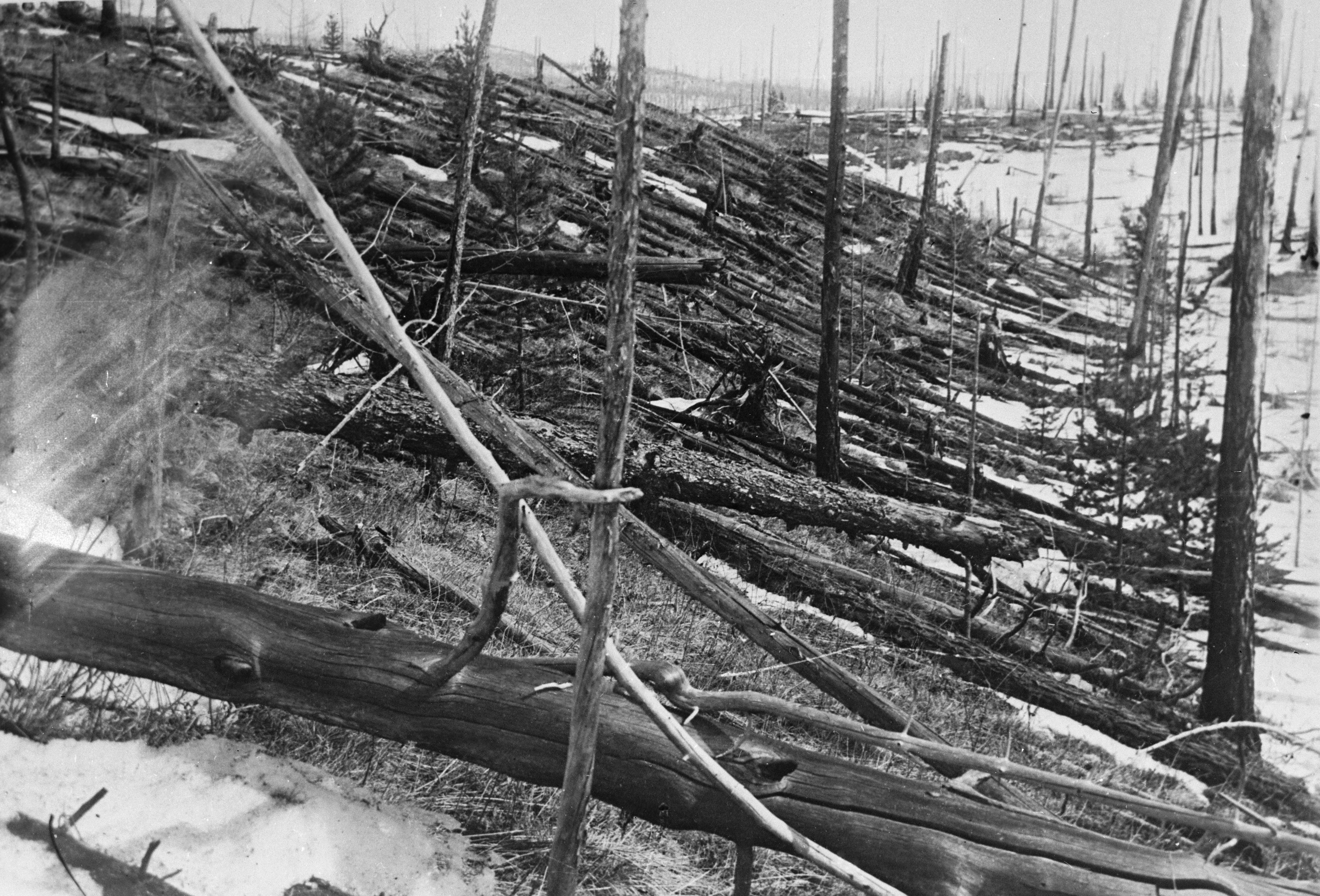
Tunguska is the kind of case that shows why the archive should not treat explanation as a loss. On the morning of June 30, 1908, a violent blast shook a remote region of Siberia. People saw light, felt heat and heard detonations. Forest was flattened across a vast area. Yet when scientific teams eventually reached the site, there was no neat crater waiting to explain everything.
That absence became the opening through which speculation rushed. If no crater, then what? For decades, Tunguska attracted theories ranging from comet fragments to antimatter, natural gas explosions, secret devices and visitor mythology. Some ideas were attempts at science under difficult evidence conditions; others were ornaments placed on a powerful blank.
The physical scene did not stay blank. Expedition photographs and surveys documented trees pushed outward in patterns consistent with a massive blast above the ground. Near the centre, some trunks remained upright but stripped, a detail that became important in reconstructing the geometry of the explosion. The forest was not telling a ghost story. It was recording force.
The modern mainstream reading is an atmospheric airburst: a space rock or cometary body entered Earth’s atmosphere and exploded before impact. That model accounts for the shock wave, the broad damage field and the missing crater. It also makes Tunguska a warning rather than merely a curiosity. The event belongs to planetary defence as much as strange history.
Witness testimony still matters. Reports of heat, sky brightness and sound give the event human scale, especially because the area was so remote. But testimony alone did not solve Tunguska. The case became useful when field observation, later modelling, astronomy and geology were brought together.
For Devil’s Hideout, Tunguska is a model of responsible wonder. It was extraordinary. It was frightening. It disrupted ordinary expectations. And yet the strongest explanation does not require abandoning physics. The mystery is not ‘anything could have happened’; it is how much can be learned from a damaged forest and a delayed investigation.
That is why Tunguska sits in the anomalous science shelf rather than the debunking shelf. It was not a hoax and not merely folklore. It was a real event that taught researchers how the sky can reach the ground without leaving a conventional wound.
Why No Crater Matters
A missing crater once made the event seem stranger than an impact. The airburst model turns that absence into evidence: the destructive energy was released above the surface.
Responsible Status
The exact object and details remain debated, but the broad class of explanation is strong enough to mark the case explained in principle rather than unexplained.
Case Notes
- Claim
- A huge explosion flattened a vast area of Siberian forest in 1908, but no ordinary impact crater was found.
- Background
- The remote location delayed scientific investigation. Later expeditions documented radial tree-fall and blast effects consistent with an atmospheric explosion.
- Reported events
- Witnesses described a fireball, heat, shock waves and sound. Expeditions later found trees flattened across a broad area, with some near the centre left standing but stripped.
- Possible explanations
- The mainstream explanation is an asteroid or comet fragment exploding in the atmosphere before reaching the ground.
- Sceptical view
- Exotic theories are unnecessary: an airburst explains the lack of crater and the scale of forest damage without invoking secret weapons or supernatural causes.
- Why it still interests people
- Tunguska remains fascinating because it is both genuinely dramatic and scientifically tractable: a real anomaly that became more understandable through patient investigation.
- People or entities
- Local Evenki witnesses, Leonid Kulik, Russian expedition teams
Sources and Further Reading
- NASA: 115 Years Ago, the Tunguska Asteroid Impact EventNASA historical overview of the event and airburst interpretation.
- Britannica: Tunguska eventConcise reference overview.
- Wikimedia Commons: Tunguska expedition photographPublic-domain image used for this entry.
Claim, Context and Cautions
- Why No Crater Matters
- A missing crater once made the event seem stranger than an impact. The airburst model turns that absence into evidence: the destructive energy was released above the surface.
- Responsible Status
- The exact object and details remain debated, but the broad class of explanation is strong enough to mark the case explained in principle rather than unexplained.
Sources and Further Reading
- NASA: 115 Years Ago, the Tunguska Asteroid Impact EventNASA historical overview of the event and airburst interpretation.
- Britannica: Tunguska eventConcise reference overview.
- Wikimedia Commons: Tunguska expedition photographPublic-domain image used for this entry.